Why did a broker turn you down?
Why did a broker turn you down?
A broker passed on you and wouldn't say why. That's a question with an answer, and most of the time the answer is sitting on your federal record.
Getting passed over doesn't mean you did something wrong. Sometimes the record is wrong. Sometimes it's out of date. Sometimes it's something you were never shown.
Here's what actually trips the screen, and what you can do about each one.
A turndown isn't a verdict
When a broker's software flags you, it isn't judging you. It's reading a file. And the file has holes in it. It's built from public data and scraps. It's wrong in exactly the places that hurt a good operator.
You can be doing everything right and still read as a risk. It's usually something on paper you've never seen.
The wrong entry that isn't yours
Wrong entries sit on records for years. Maybe a citation got miscoded. Maybe an inspection got tied to the wrong carrier. Maybe something got thrown out but never came off your file.
It quietly pulls your record down, and it keeps pulling until somebody takes it off.
You can challenge these. There's a federal process for it. It's confusing and it feels stacked against you, which is why hardly anybody files. But wrong entries do come off when you push. Clearing one is one of the fastest ways to move your record.
The filing you didn't know had lapsed
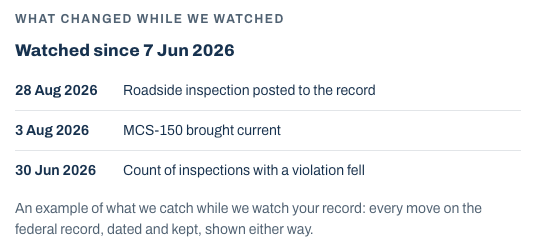
Records go stale. An old MCS-150, a filing that expired, a detail that changed and never got updated. The software reads stale as risk.
Since May there's a catch. A lot of carriers got locked out of their own federal account in the system changeover. If you can't get in, you can't fix anything, and you might not even know you're locked out. Getting back into your own account is step one. Everything else waits behind it.
What the record doesn't say about you
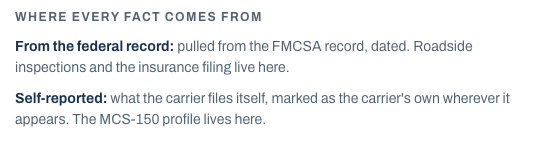
A lot of what makes you a good carrier isn't in the public file at all. Your track record with the brokers you've hauled for. The government's own safety percentiles, held private since 2015. The full picture of how good you are can only be built with your say-so, from your side.
That's the record worth building, so you have proof when a broker asks.
What to do now
Start by seeing what they see. Run your score, free, ten seconds, your USDOT number. It shows you what's on your record and how much of it we could read.
From there you'll know what you're dealing with: a wrong entry, a stale filing, or a gap only you can fill. A turndown you can see is a turndown you can fix.
If you want to know what that software is reading and how the number gets made, we wrote that up too: The number brokers see before they call you back.